

The Dust Rises Again in America’s Auto Heartland
A familiar silhouette is emerging from the red clay of South Carolina, bringing with it a shockwave that could redefine the American truck market. Scout Motors, the electric vehicle (EV) subsidiary of the massive Volkswagen Group, isn’t just dusting off a classic name; it’s placing a $2 billion bet on the heartland of American manufacturing. The stakes are monumental, not just for the company, but for thousands of working families across the United States.
For decades, the original International Harvester Scout was the rugged, no-nonsense utility vehicle of choice—a true American pioneer. Now, its electric rebirth promises to be either a revolutionary success story or a costly failure. The problem facing millions of Americans today is that many new EVs sacrifice toughness for high-tech flash, leaving a gap for the rugged, dependable truck designed for work and weekend adventure.
This venture directly impacts US consumers who demand capability without compromise and affects thousands in South Carolina and North Carolina counting on the promised 4,000+ manufacturing jobs. The economic engine of the South is revving up, but internal disputes and a looming battle over how these vehicles are sold threaten to derail this massive industrial movement.
This article will pull back the curtain on the Scout Motors saga, detailing the colossal economic footprint, the controversial direct-sales model that has the entire US dealer network up in arms, and the highly anticipated new Traveler SUV and Terra pickup that aim to capture the soul of the American road. We’ll analyze the political and financial drama unfolding in the Carolinas and explain exactly how this reborn icon could reshape the roads—and job reports—across the nation.
Table of Contents
1. The Rebirth of an American Legend: Why the Scout Matters
Scout Motors is not just another startup; it is the resurrection of a vehicle that helped invent the modern SUV. The original International Harvester Scout, produced from 1961 to 1980, was a cultural landmark—a utility vehicle designed for the farmer, the adventurer, and the everyday American who needed reliability and capability in equal measure.
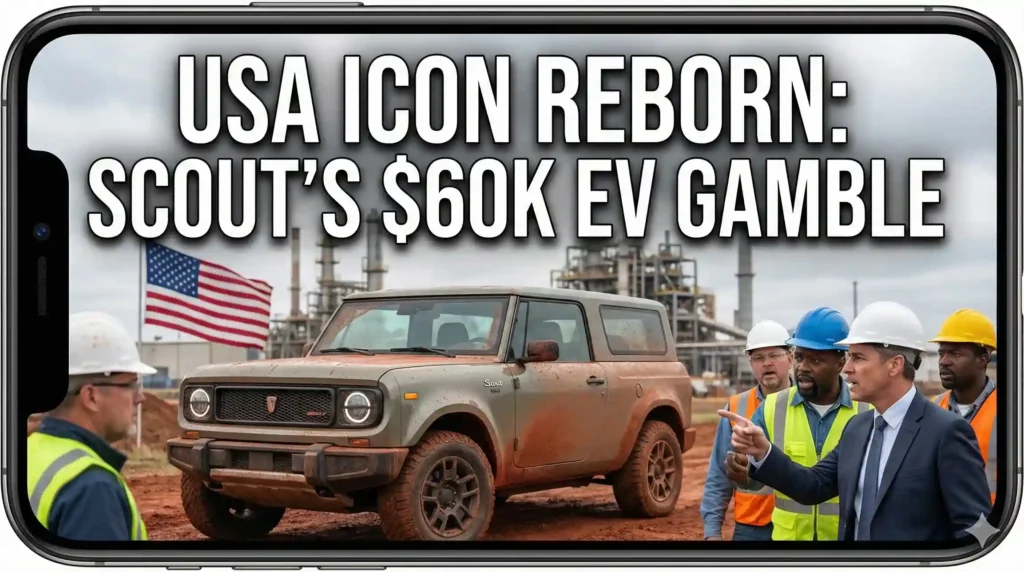
The current automotive landscape is flooded with sleek, high-tech SUVs that often forget their roots. The modern Scout is aiming squarely at the consumer who feels left behind, mixing deep American nostalgia with future-forward electric power. This blend of legacy and innovation is the core of its appeal, turning a business venture into a cultural story.
The DNA of Utility and Endurance
The legacy is simple: the original Scout didn’t try to be fancy; it tried to be tough. The new version carries this philosophy forward, focusing on durability and real-world utility over purely aerodynamic efficiency.
- Original Scout Attributes:
- Unbreakable durability.
- Body-on-frame construction.
- Simple, repairable engineering.
- Modern Scout Promise:
- Electric power meeting rugged, mechanical toughness.
- High ground clearance and robust axles designed for the backroads.
- A focus on **”real controls”—**physical knobs and buttons, not just touchscreens.
The VW Connection: Backing the American Dream
While Scout Motors operates as an independent company based in the U.S. (headquartered in Charlotte, NC), it is wholly owned by the Volkswagen Group. This backing provides immense financial stability, engineering expertise, and access to a global supply chain that most startups can only dream of. This marriage—American heritage powered by German financial muscle—is crucial for hitting their ambitious production targets. This ensures Scout isn’t a flash-in-the-pan, but a grounded entry into the American auto sector.
2. The $2 Billion Bet: Scout’s Massive South Carolina Footprint
The economic impact of Scout Motors is concentrated in one monumental location: Blythewood, South Carolina. Here, on a sprawling 1,600-acre site less than 20 miles north of Columbia, the company is building a state-of-the-art manufacturing center. This is more than a factory; it is a declaration of commitment to American reshoring and domestic production.
The sheer scale of the investment—$2 billion—is a headline in itself, positioning this as one of the largest economic development projects in Richland County history.
The Manufacturing Center’s Scope
The South Carolina facility is designed for high-volume, domestic production, ensuring that when the new Traveler and Terra roll off the line, they can truly wear the “American Built” badge.
- Location: Blythewood, Richland County, South Carolina.
- Investment: $2 billion (initial capital outlay).
- Capacity: Targeting a peak capacity of 200,000 vehicles per year, or roughly 40 vehicles per hour.
- Strategic Advantage: The site’s proximity to major interstate highways (I-77), the bustling ports of Charleston and Savannah, and regional talent hubs makes it ideal for supply chain logistics and talent recruitment.
The Wetland Hurdles and Commitment
Building on a plot of this size in the US often involves complex environmental negotiations. Scout Motors faced initial construction pauses in late 2023 due to concerns raised by environmental groups and federal agencies regarding wetland development. The company successfully navigated these issues, securing final permitting approval by committing to extensive wetland preservation efforts elsewhere in the state. This required demonstrating a genuine commitment to responsible development, easing the concerns of stakeholders across the state.
3. Jobs and Economic Shockwave: The Human Angle in Blythewood
This story transcends metal and batteries; it’s about people. The most immediate and critical impact of the Scout project is the promise of thousands of jobs and the resulting economic revitalization for the Midlands region of South Carolina. The job creation figures represent real opportunity for American workers seeking stability and a future in the booming electric vehicle sector.
The Power of 4,000 New Jobs
The company has explicitly stated its plans to create at least 4,000 permanent jobs at the Blythewood manufacturing facility. These are not low-wage positions; they are skilled, long-term careers in automotive assembly, engineering, maintenance, and logistics.
The Local Impact:
- Training Investment: The state of South Carolina has already made significant efforts to bolster technical college programs, preparing the local workforce for the specialized demands of EV manufacturing.
- Community Growth: The influx of 4,000 workers will necessitate growth in local services, housing, and infrastructure, providing a long-term economic boost to Richland County and surrounding areas.
- Career Pathways: Scout Motors is actively working with South Carolina’s technical college system to establish clear career pathways, ensuring that locals have the skills needed to fill these high-demand, high-paying roles.
Supplier Opportunities and Regional Growth
A massive auto plant requires a massive network of suppliers. Scout Motors has plans to invest an additional $300 million to build a dedicated supplier park near the main production center. This park is intended to co-locate key suppliers, streamlining the supply chain and further concentrating economic activity.
- Tier 1 and 2 Suppliers: Companies that provide everything from stamped metal parts to interior components and specialized EV batteries (expected partly from VW’s PowerCo network) will establish operations nearby.
- Small Business Injection: Local businesses—restaurants, construction firms, housing developers, and service providers—will experience a ripple effect as the manufacturing workforce settles in, creating a sustainable economy around the new industrial hub.
4. Introducing the New Icons: Traveler SUV and Terra Pickup Specs
Scout Motors is launching with two distinct models that directly pay homage to the original lineup: the Traveler SUV and the Terra pickup truck. Both are built on an all-new, proprietary electric platform designed from the ground up for serious off-road capability.
The Traveler SUV: Modern Overlanding Capability
The Traveler is the modern incarnation of the classic two-door SUV, designed to be both a rugged daily driver and a serious overlanding machine.
- Target Buyer: Environmentally conscious families and adventurers who need room for gear and people, but demand capability far beyond the average crossover.
- Key Design Features:
- Signature Silhouette: Maintains the boxy, recognizable profile of the original Scout.
- Cabana Roof: Features a retractable sliding roof, offering one of the largest open-air roof openings in any SUV for an immersive outdoor experience.
- Front Trunk (Frunk): Designed to convert into front-row seating for tailgates or campsites.
The Terra Pickup: Built to Haul and Endure
The Terra is Scout’s answer to the need for a truly capable, electric pickup that respects the heritage of the American workhorse. It focuses on the utility and payload capacity demanded by construction workers, farmers, and serious DIYers.
- Target Buyer: Those needing a durable tool for the job site or serious recreational towing.
- Utility Highlights:
- Goldilocks 5.5 ft Bed: A practical size for everyday use and large equipment.
- Retractable Rear Window: Allows for open-air driving and hauling of long items.
- Onboard Power: Features a 240-volt onboard power outlet, multiple 120V outlets, and numerous USB-C ports to power tools, campsites, or emergency equipment.
- Performance Projection: The Terra is engineered to deliver a projected 10,000+ pounds of towing capacity and nearly 2,000 pounds of payload.
5. Powering the Pioneer: EV, EREV, and the Range Debate
One of the most crucial and differentiating aspects of Scout’s strategy is its refusal to commit solely to battery-electric vehicles (BEV). Recognizing the needs of rural American buyers, who often face limited charging infrastructure, Scout is planning for two distinct powertrain paths.
Pure Electric Capability
The standard models of the Traveler and Terra will be all-electric, utilizing dual-motor, all-wheel-drive setups.
- Performance: Expected to provide robust power and instant torque, crucial for off-road maneuvering and heavy towing.
- Range Target: Pure electric models are targeting a competitive 300–400 miles of range, aligning with market expectations for long-distance adventure vehicles.
- Charging Standard: Scout is adopting the North American Charging Standard (NACS), ensuring access to the rapidly growing network of fast chargers across the US.
The Range Extender Pivot: EREV Technology Explained
In a strategic move to alleviate consumer range anxiety, especially in remote US locations, Scout has pivoted to offer an Extended-Range Electric Vehicle (EREV) option.
- The Technology: An EREV uses a small, gas-powered generator (an internal combustion engine) that does not directly drive the wheels but instead charges the battery when it runs low. This offers a major safety net.
- The Benefit for Americans: For drivers traveling through areas with sparse EV charging—like parts of Montana, West Texas, or rural Alaska—the EREV option provides the confidence of being able to refuel with gasoline, offering a total projected range of 500 miles or more.
- Market Flexibility: This dual-powertrain approach provides Scout flexibility, especially as the EV market experiences periods of cooling demand, allowing them to capture buyers who are EV-curious but not yet ready for a pure electric commitment.
6. The Direct Sales War: Why Dealers are Suing Scout Motors
In one of the biggest unfolding battles in the American auto industry, Scout Motors has chosen a direct-to-consumer sales model—meaning they will sell vehicles online and through their own Scout Workshop retail stores, completely bypassing the traditional franchised dealership network. This decision has sparked intense legal and political firestorms across the USA.
The Lawsuit Threat and Consumer Choice
The National Automobile Dealers Association (NADA) and numerous state dealer groups, including those in California and the Southeast, have filed lawsuits against Scout Motors and its parent, Volkswagen.
- The Dealers’ Argument: Franchised dealers argue that Scout, as a subsidiary of VW (which already operates with dealers), is violating state franchise laws that prohibit an automaker from competing directly with its own existing dealer network. They view direct sales as an existential threat to their multi-million dollar investments.
- Scout’s Promise: Scout defends its model by citing increased transparency and trust for the consumer. They promise a single, upfront price with “no delivery day surprises” and no junk fees—a key driver for consumer preference in the modern vehicle market.
The South Carolina Dealer Drama
The direct sales debate became a local political flashpoint in South Carolina.
- The Incentive Dilemma: Despite the state granting Scout $1.3 billion in incentives to build the factory, state law still mandates that vehicles be sold exclusively through dealers.
- The Legislative Stalemate: A bipartisan bill (H. 3777) was introduced to modify the law, specifically allowing EV makers that operate manufacturing plants in South Carolina to sell directly. The bill faced fierce resistance from powerful dealer lobbying groups and stalled, meaning that unless the law changes, even the 4,000 workers building the Scout in Blythewood will have to travel to a neighboring state (like North Carolina) to buy the vehicle they manufacture. This irony provides a powerful human-interest angle to the legal battle.
7. A Tale of Two Carolinas: Headquarters Dispute and Political Fallout
While the manufacturing heart of Scout beats in South Carolina, a recent decision has created political tension and economic rivalry between the two states: Scout chose Charlotte, North Carolina, as its corporate headquarters.
The Charlotte Corporate Hub
The decision to locate the corporate headquarters in North Carolina, just over the state line from Blythewood, will bring a different class of high-paying jobs to the region.
- Job Profile: The Charlotte office will host 1,200 high-paying, white-collar corporate positions, including engineering, marketing, and commercial operations. The average salary for these roles is projected to be exceptionally high, bringing significant capital investment to the Queen City.
- North Carolina’s Win: Charlotte beat out sites in both South Carolina and Virginia, securing one of the region’s biggest job creation announcements in recent memory. This move underscores the power of state-level economic development incentives and talent recruitment.
Economic Incentive Package Analysis
The split location—manufacturing in SC, corporate leadership in NC—has sparked criticism and scrutiny, especially in South Carolina, which offered massive incentives for the manufacturing plant.
- The SC Investment: South Carolina’s $1.3 billion package was designed to land both the plant and the corporate jobs. The political fallout centered on why the company was allowed to take the manufacturing jobs while placing the high-wage, corporate jobs elsewhere.
- The Political Message: The debate sends a clear signal to state policymakers across the USA: economic development deals must be written with ironclad guarantees about the specific types and locations of jobs created. The tension highlights the fierce interstate competition for jobs in the booming American auto sector.
8. The Under-$60K Question: Pricing and the Middle-Class Buyer
Scout Motors has publicly targeted an entry price point of under $60,000 for its base models. This pricing strategy is critical, as it places the Traveler SUV and Terra truck squarely in the territory of the upper-middle-class buyer, rather than the ultra-luxury segment.
Affordability in the Off-Road Segment
The off-road and utility segment is facing rising costs. Many new EV trucks and SUVs, such as the Rivian R1T, begin well above $70,000, making them inaccessible to the traditional truck buyer.
- Target Market Comparison: By targeting the sub-$60K price point, Scout is aiming to directly compete with the higher trims of the Ford Bronco, the Jeep Wrangler 4xe, and the F-150 Lightning, providing a rugged, American-built electric alternative at a comparable cost.
- Mass Appeal: Achieving this price point is crucial for Scout to move from a niche brand to a high-volume manufacturer that can actually produce 200,000 units annually, fulfilling its economic promises to South Carolina.
Transparent Pricing Promise
Part of Scout’s direct-sales pitch is the promise of price transparency.
- No Markups: The company aims to eliminate the massive dealer markups and hidden fees that have plagued the industry, especially during periods of high demand.
- Digital Experience: Customers will know the final price of their vehicle from the moment they reserve it online to the day they take delivery, simplifying the purchase experience—a key element for the modern, digital-first consumer.
9. Rivals on the Trail: Scout vs. Bronco, Wrangler, and R1T
The off-road utility segment is fiercely competitive, dominated by established American legends. Scout is entering a cage match where heritage and capability are non-negotiable standards.
Facing the Traditional Giants (Ford and Jeep)
The Traveler and Terra are designed to challenge the reigning kings of American off-roading: the Ford Bronco and the Jeep Wrangler.
| Feature | Scout Terra/Traveler (Projected) | Ford Bronco/Wrangler (ICE/Hybrid) | The Edge |
| Powertrain | All-Electric (BEV) or Range Extender (EREV) | Traditional Gasoline or Mild Hybrid | Scout: Future-proofed electric/EREV system. |
| Platform | All-New Proprietary Body-on-Frame | Proven Body-on-Frame | Scout: Designed specifically for EV architecture toughness. |
| Max Towing | 10,000+ lbs (Terra) | Up to ~7,500 lbs (Bronco/Wrangler) | Scout: Superior torque and capacity driven by electric motors. |
| Focus | Utilitarian Electric Adventure | Pure Off-Road Capability | Scout: Targeting the convergence of tech, work, and off-road. |
Challenging the EV Pioneers (Rivian and Tesla)
Scout must also differentiate itself from the new wave of electric utility vehicles that already have a head start, namely the Rivian R1T/R1S and the Tesla Cybertruck.
- Scout vs. Rivian: Rivian is known for its high-tech, premium adventure vehicles with a price tag often starting above $73,000. Scout is aiming to undercut that price while maintaining equivalent or superior ruggedness, focusing on mechanical components like physical lockers and classic truck features rather than Rivian’s more sophisticated, independent suspension setup.
- Scout vs. Tesla Cybertruck: Where the Cybertruck leans into a radical, futuristic design, Scout leverages nostalgic Americana and proven utility design principles. Scout’s focus is on real-world use and traditional truck buyer acceptance, not boundary-pushing aesthetics.
10. Engineered for the Off-Road: Body-on-Frame and Rugged Tech
The primary engineering decision that signals Scout’s commitment to rugged capability is the use of a proprietary, all-new body-on-frame platform. This is a technical detail that speaks volumes to the off-road community and demonstrates the company’s understanding of its heritage.
The Importance of Body-on-Frame
Most modern electric vehicles (and many traditional SUVs) use a unibody construction, where the body and frame are one unit. While this improves on-road comfort and weight, it sacrifices extreme durability.
- Body-on-Frame Advantage: Separating the body from a robust chassis provides superior strength for absorbing massive impacts, accommodating massive axle articulation for rock crawling, and handling the extreme stresses of towing and heavy payload. This is the foundation of a true work vehicle.
- Mechanical Lockers: Scout plans to include front and rear mechanical locking differentials. This is a non-negotiable feature for serious off-roaders, ensuring power is delivered to all wheels regardless of traction loss—a capability often missing or optional on less rugged vehicles.
Towing and Payload Capacity
The sheer utility of these vehicles is engineered to surpass many current competitors. The strength of the electric powertrain provides immense, instantaneous torque necessary for pulling heavy loads.
- Towing Leader: The Terra truck’s 10,000-pound-plus towing target is a major differentiator in the EV truck space, putting it on par with some of the best gasoline-powered heavy-duty vehicles.
- Utility Focus: Beyond the major features, Scout is integrating utility throughout the design, including robust grab handles, tactile controls that can be operated with work gloves on, and materials chosen specifically for durability and ease of cleaning after a long day on the job site or the trail.
11. The Timeline Tightrope: Production Targets and Customer Wait
The journey from groundbreaking ceremony to vehicles on the road is long and fraught with potential delays, especially for a new US-based automotive factory and a brand-new platform. The current timeline is aggressive, creating urgency for consumers and investors alike.
Navigating Construction and Permits
The $2 billion South Carolina Production Center broke ground in early 2024, aiming for rapid development. The goal is to move from construction to tool installation swiftly.
- Pre-Production Target: Late 2026. This phase involves building initial prototypes and testing the manufacturing line, a critical step to identify and eliminate early bugs.
- Series Production Start: Initial series production is currently targeted for late 2027. This date is crucial and provides a competitive window, but the sheer complexity of launching a new US factory means any environmental or supply chain hurdle could push this date back.
When Can You Buy a Scout?
For the average American consumer, the focus is on when they can finally get their hands on a Traveler or Terra.
- Reservations: Scout has already opened reservations, allowing early adopters to put down a deposit. This signals high consumer interest and provides the company with valuable early demand data.
- Retail Sales: The first retail sales are expected to occur shortly after the start of series production, likely beginning in late 2027 or early 2028. The company is simultaneously building its network of Scout Workshops (retail/service centers) across the US and Canada to manage the direct delivery and service process.
12. The Future of American Utility: Scout’s Long-Term Vision
Scout Motors isn’t just focused on its first two vehicles; it views the Traveler and Terra as the beginning of a long-term commitment to the American utility segment. The goal is not just to sell 200,000 vehicles, but to become an integral, trusted part of the U.S. automotive landscape once again.
Building a Digital and Physical Ecosystem
The modern automotive company must offer a seamless experience. Scout’s direct model allows for total control over the customer journey.
- Community UX: The vehicles will feature a digital ecosystem called “Community UX” designed for sharing, allowing co-pilots easy control over entertainment and navigation—a nod to the shared adventure experience.
- One App, One Login: From reservation to scheduling service, the entire ownership experience is centralized in a single digital platform, prioritizing customer convenience and eliminating layers of complexity often associated with traditional dealerships.
The Legacy of American Ingenuity
At its core, the Scout revival represents more than just a product; it’s the re-establishment of an American icon, built by American workers, in an American factory, specifically for the US consumer. The focus on rugged capability, coupled with the flexibility of the EREV option, suggests a deep understanding of what American drivers actually need in a transitionary EV market. If Scout Motors successfully navigates the political and production tightrope, it will be viewed as a monumental case study in how to resurrect a beloved brand and inject billions into the domestic manufacturing sector for generations to come.
Frequently Asked Questions (FAQs)
Q: What is Scout Motors, and who owns the company?
A: Scout Motors is an American electric vehicle manufacturer founded in 2022. It is a wholly-owned subsidiary of the Volkswagen Group. It operates as an independent company, focused on reviving the classic International Harvester Scout nameplate as a brand of rugged, all-electric and range-extended trucks and SUVs.
Q: Where will the new Scout Traveler and Terra vehicles be built?
A: The vehicles will be built at a brand-new, $2 billion Production Center currently under construction in Blythewood, South Carolina. This facility is expected to create over 4,000 permanent manufacturing jobs for the region.
Q: What is the estimated starting price and release date for the Scout vehicles?
A: Scout is targeting an entry-level price point of under $60,000 for both the Traveler SUV and the Terra pickup truck. Initial production is targeted to begin in late 2027, with retail sales starting shortly thereafter.
Q: Will the new Scouts be purely electric, or will they have a gas engine?
A: Both the Traveler and Terra will be offered as pure electric vehicles (BEV). Crucially, Scout has also announced plans for a Range-Extended Electric Vehicle (EREV) option, which uses a small gasoline engine as a generator to charge the battery, offering drivers 500 miles or more of total range and eliminating range anxiety.
Q: Why are car dealers across the USA fighting Scout Motors?
A: Scout has chosen a direct-to-consumer sales model, bypassing the traditional franchised dealer network (similar to Tesla or Rivian). Dealership associations are suing because they argue this model violates state laws that mandate vehicles be sold through franchised dealers, viewing it as unfair competition.
The revival of Scout Motors is far more than just the launch of two new utility vehicles; it is a critical litmus test for the American automotive future. It represents a major financial commitment to domestic manufacturing, offering thousands of skilled jobs in South Carolina and planting a corporate hub in North Carolina. It challenges entrenched power structures through its direct sales model and promises to deliver a truly rugged, capable EV that respects the needs of the working American.
The road to production is long, marked by political battles, logistical challenges, and the intense pressure of a $2 billion investment. But if Scout can deliver on its promise of an American-built, capable, sub-$60,000 utility vehicle, it stands to not only reclaim an iconic name but also to successfully redefine the electric vehicle landscape for the next generation of American pioneers.
For more breaking USA news, economic analysis, and updates on the evolving American auto industry, visit https://righway.com/ daily.