
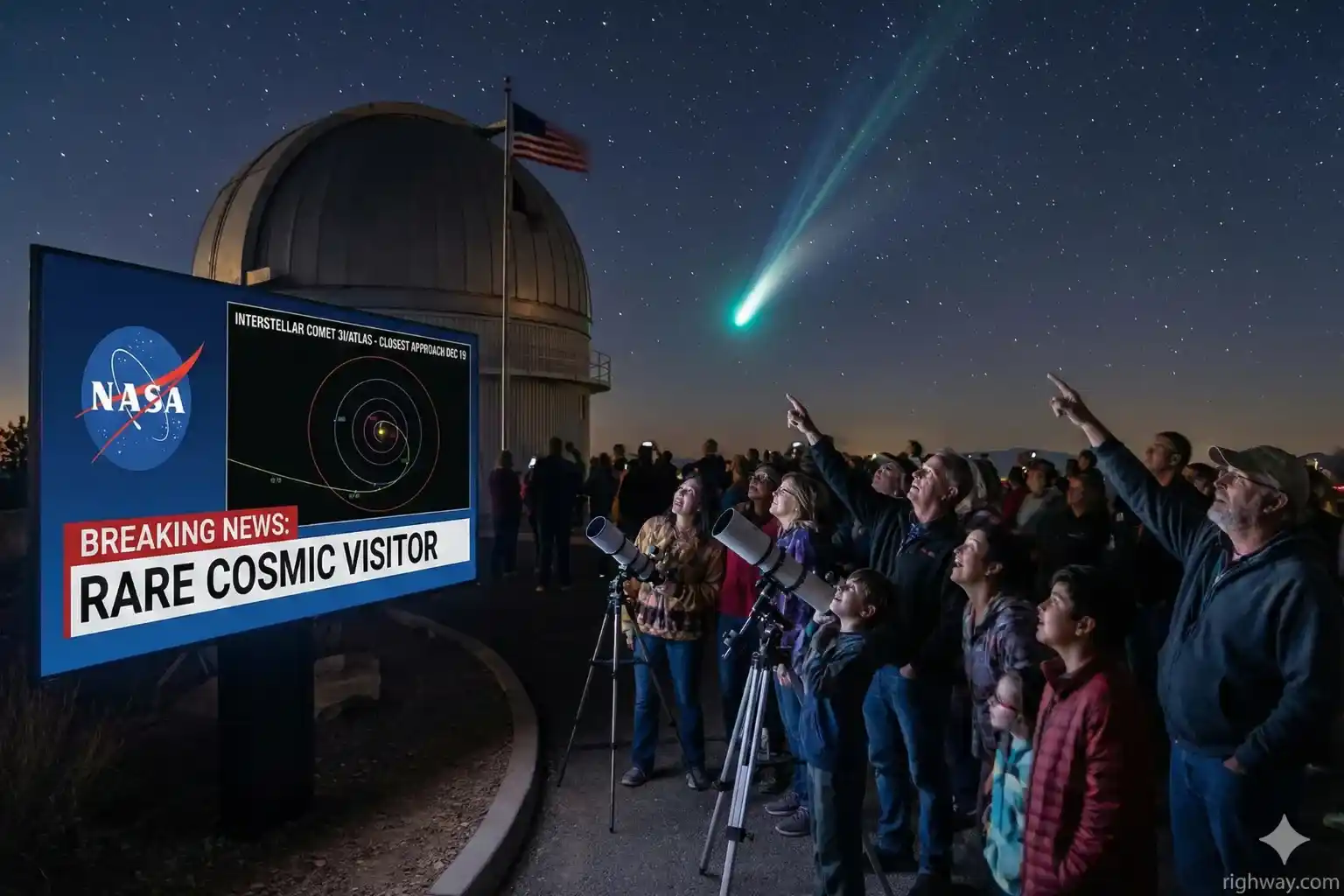
Interstellar Comet 3I ATLAS Is Here & It’s Unlike Anything We’ve Seen
By Harjeet / Righway News Desk
Published: December 6, 2025 | Updated: 5 Minutes Ago
WASHINGTON, D.C. — It came from the deep freeze of the galaxy, slipping silently past Jupiter before anyone knew it was there. Now, the object designated 3I/ATLAS is making its closest approach to Earth, and it has brought a shocking surprise packed inside its icy shell.
For only the third time in history, humanity is watching a visitor from another star system streak through our cosmic backyard. But unlike its predecessors—the cigar-shaped ‘Oumuamua and the ghostly Borisov—Comet 3I/ATLAS is rewriting the textbooks. NASA astronomers have just confirmed that this “cosmic traveler” is venting massive amounts of methanol and hydrogen cyanide, the very chemical backbones required for life.
As the comet races toward its closest encounter with Earth on December 19, 2025, the scientific community is buzzing with a mix of excitement and urgency. Is this just a dirty snowball from a distant star, or is it a “message in a bottle” proving that the ingredients for life are common across the universe?
Here is everything American readers need to know about the object that has turned eyes skyward from NASA’s Goddard Space Flight Center to Harvard University.
Table of Contents
- The Discovery: A Ghost from the Galactic Deep
- The ‘Methanol Monster’: Why NASA is Shocked
- Alien Tech or Natural Wonder? The Avi Loeb Debate
- Timeline: The December 19 Close Approach
- How 3I/ATLAS Compares to ‘Oumuamua
- Can You See It? Viewing Guide for the USA
- Frequently Asked Questions
- Conclusion
The Discovery: A Ghost from the Galactic Deep
On July 1, 2025, the Asteroid Terrestrial-impact Last Alert System (ATLAS) telescope in Hawaii—funded by NASA to spot dangerous space rocks—pinged an anomaly. It wasn’t an asteroid. It wasn’t a normal comet.
The object was moving too fast.
While typical comets from our own Solar System orbit the Sun in predictable loops, this object was tearing through space at a blistering 137,000 miles per hour (approx. 60 km/s). Its trajectory was hyperbolic, a mathematical dead giveaway that it was not bound by our Sun’s gravity. It was a drifter, unchained and just passing through.
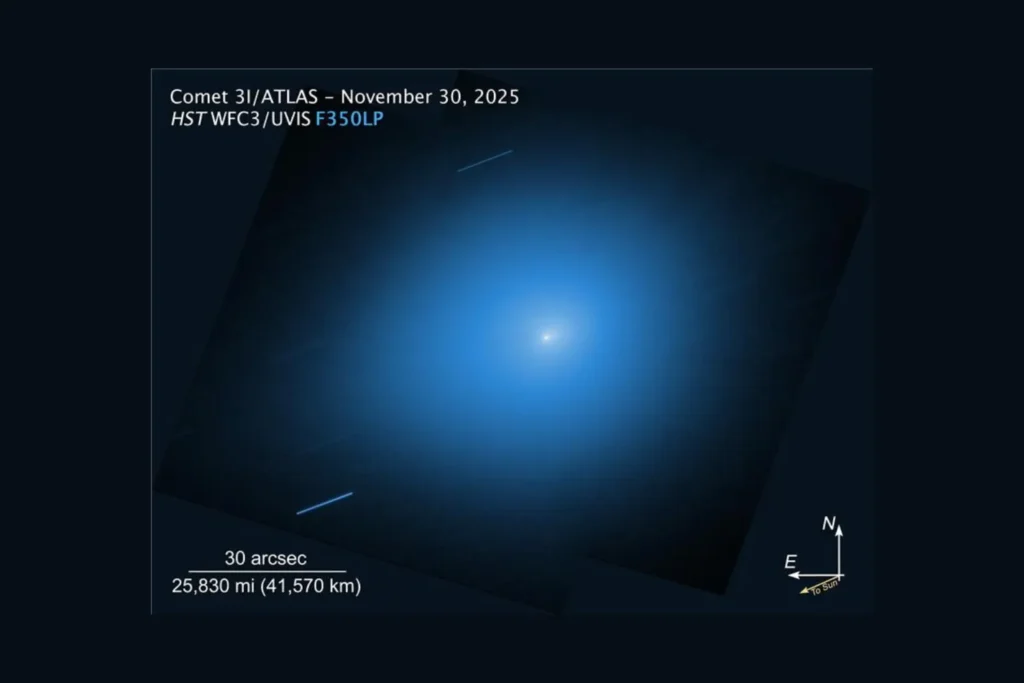
Officially cataloged as 3I/ATLAS (the “3I” standing for the 3rd Interstellar object ever detected), it joins an exclusive club.
- 1I/‘Oumuamua (2017): The reddish, tumbling “cigar” that baffled scientists.
- 2I/Borisov (2019): A rogue comet that looked surprisingly like our own.
- 3I/ATLAS (2025): The chemical factory.
“This isn’t just another rock,” said Dr. Martin Cordiner, a researcher at NASA’s Goddard Space Flight Center, in a recent press briefing. “It’s a sample from a solar system that formed billions of years ago, perhaps light-years away. It’s delivering data to our doorstep.”
The comet is currently hurtling through the inner solar system, having already survived a close shave with Mars in October. Now, it swings back toward the dark, but not before giving Earth a front-row seat.
The ‘Methanol Monster’: Why NASA is Shocked
If ‘Oumuamua was the “mysterious scout” and Borisov was the “ghost,” 3I/ATLAS is the “chemist.”
In breaking news released this week, astronomers using the Atacama Large Millimeter/submillimeter Array (ALMA) reported startling findings. As the Sun’s heat warmed the comet’s surface, 3I/ATLAS began to scream—chemically speaking.
The comet is ejecting methanol (a simple alcohol) and hydrogen cyanide (HCN) at unprecedented rates.
- Methanol Production: Approximately 40 kilograms (88 lbs) per second.
- Comparison: This is significantly higher than almost any comet native to our Solar System.
Why Does This Matter?
To the average person, “methanol” might sound like camping fuel. To an astrobiologist, it sounds like life.
Methanol and hydrogen cyanide are considered “prebiotic” molecules. They are the LEGO bricks of organic chemistry. Under the right conditions, these molecules can react to form amino acids—the building blocks of proteins and life as we know it.
Finding such a rich stockpile on a visitor from another star system implies a massive realization: The chemistry that started life on Earth might not be unique to Earth.
If a random comet from a random star is dripping with life-ingredients, the galaxy could be teeming with biological potential. 3I/ATLAS suggests that our universe is not a barren wasteland, but a soup of organic possibility waiting for the right planet to land on.
Alien Tech or Natural Wonder? The Avi Loeb Debate
You can’t talk about interstellar objects without addressing the elephant in the room: Aliens.
Since 2017, Harvard astrophysicist Avi Loeb has famously argued that interstellar objects (specifically ‘Oumuamua) displayed behavior so strange they could be artificial—discarded solar sails or probes from an extraterrestrial civilization.
Does 3I ATLAS fit the bill?
The “Anti-Tail” Phenomenon
Early observations of 3I/ATLAS showed a bizarre feature known as an “anti-tail”—a spike of dust pointing toward the Sun rather than away from it. In standard physics, solar wind pushes tails away.
- The Speculation: Internet forums and UFO enthusiasts immediately flagged this as “propulsion” or “exhaust.”
- The Science: NASA explains that “anti-tails” are a rare but natural optical illusion caused by the viewing angle of Earth relative to the comet’s dust plane.
However, the high ratio of carbon-rich molecules has reignited the debate. Why is the composition so different from our local comets?
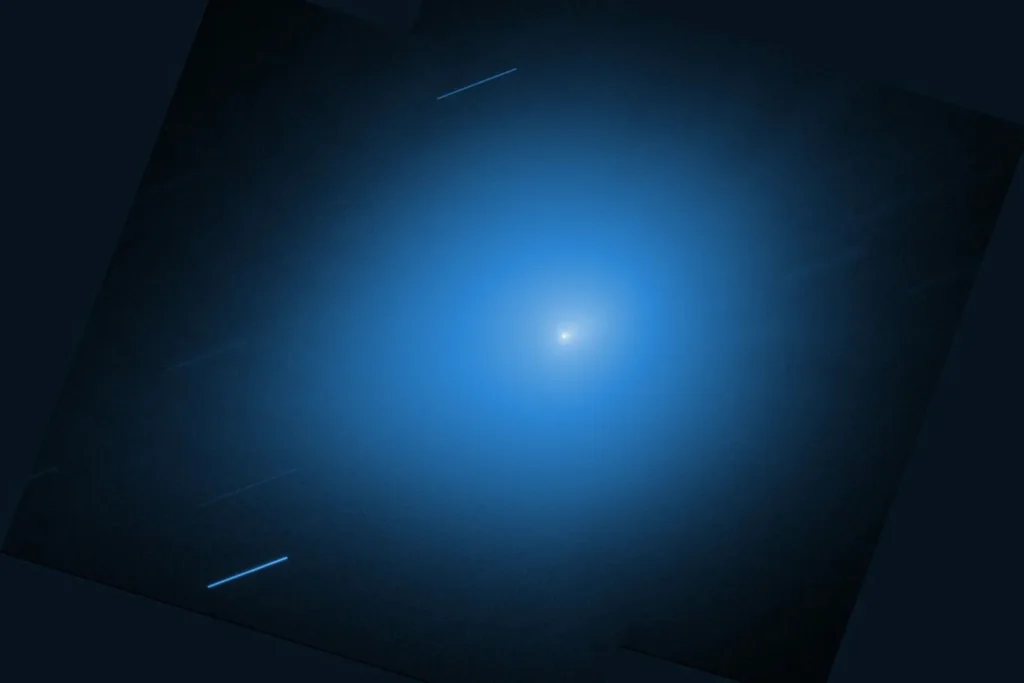
While NASA and the European Space Agency (ESA) remain firm that 3I/ATLAS is a natural body, the “artificial origin” theory continues to trend on social media platforms like X (formerly Twitter) and Reddit. For now, the consensus is clear: It’s likely a natural object, but a weird one.
Timeline: The December 19 Close Approach
The clock is ticking. 3I/ATLAS is moving so fast that it will soon be gone forever. It will never return. Here is the timeline for US observers and news watchers:
- July 1, 2025: Discovered by ATLAS survey.
- October 29, 2025: Reached Perihelion (closest point to the Sun).
- NOW (Early Dec 2025): The comet is visible to high-power telescopes and is being analyzed by the James Webb Space Telescope (JWST).
- December 19, 2025:CLOSEST APPROACH TO EARTH.
- Distance: 1.8 AU (about 167 million miles).
- Significance: This is the best window for radio telescopes to scan the comet for more complex molecules.
- January 2026: Fades rapidly as it zooms toward the outer solar system.
- 2030s: Exits our solar system entirely, drifting back into the interstellar void.
How 3I / ATLAS Compares to ‘Oumuamua
Understanding why 3I is special requires looking at its “older siblings.”
| Feature | 1I/‘Oumuamua (2017) | 2I/Borisov (2019) | 3I/ATLAS (2025) |
| Shape | Long, cigar-like | Round, fuzzy | Irregular, active nucleus |
| Composition | Rock/Metal (Little gas) | Standard Water Ice | Carbon-rich, Methanol Heavy |
| Activity | Quiet (Tumbling) | Active (Standard) | Hyper-Active (Gas venting) |
| Origin | Unknown | Likely Red Dwarf system | Unknown Carbon-rich system |
3I/ATLAS is the “Goldilocks” object. It has the weird chemistry of a mystery world but the activity of a comet, allowing us to smell its exhaust—literally.
Can You See It? Viewing Guide for the USA
This is the question every American asks: “Can I see it from my backyard?”
We have to manage expectations here. Unlike the Great Comet of 2024 (Tsuchinshan-ATLAS) that dazzled with a naked-eye tail, 3I/ATLAS is faint.
- Visual Magnitude: Hovering around +11.5.
- Naked Eye: No.
- Binoculars: Unlikely, unless you have giant astronomical binoculars (20×80) and dark skies.
- Telescope: YES. A mid-sized backyard telescope (6-inch or larger) with a camera can pick it up as a fuzzy smudge moving against the stars.
Where to Look (US Observers)
For amateur astronomers in the United States:
- Constellation: Currently moving through Virgo and entering Leo.
- Best Time: Pre-dawn hours (Early Morning).
- Method: Long-exposure photography is your best bet.
If you don’t have a telescope, don’t worry. NASA and the Virtual Telescope Project are hosting live streams online. This is the best way to witness history without freezing in the December cold.
Frequently Asked Questions
Q: Will Comet 3I/ATLAS hit Earth?
A: No. The comet will pass safely at a distance of 167 million miles—almost twice the distance between Earth and the Sun. There is zero danger of impact.
Q: Is 3I/ATLAS an alien spaceship?
A: While scientists like Avi Loeb investigate all possibilities, all current evidence points to it being a natural, carbon-rich comet. The “signals” people talk about are chemical signatures, not radio broadcasts.
Q: Why is it called “3I”?
A: The “I” stands for Interstellar. It is the third object confirmed to come from outside our solar system.
Q: Can we send a rocket to land on it?
A: Sadly, no. 3I/ATLAS is traveling at 137,000 mph. We do not currently have a spacecraft fast enough to catch it on such short notice. It is simply too fast.
Q: Where did it come from?
A: Astronomers are tracing its path backward. It came from the direction of the constellation Sagittarius, but it has likely been drifting for millions of years, unconnected to any specific star until now.
Q: Will it ever come back?
A: No. Its orbit is hyperbolic. Once it leaves our solar system, it will travel the galaxy forever, never to return to the Sun.
A Brief Hello from the Infinite
In conclusion, as Americans prepare for the holidays this December, a silent traveler is waving goodbye.
Comet 3I/ATLAS reminds us that the Earth is not a closed system. We live in a galaxy where materials, chemicals, and perhaps even the seeds of life are constantly being traded between stars. We just happened to be awake to catch this package.
For the scientists at NASA, the work is just beginning. The data harvested from 3I/ATLAS in the coming weeks will be studied for decades, helping us answer the ultimate question: Are we alone?
The comet may be leaving, but the secrets it delivered will stay with us forever.
Stay curious, America.
For more breaking space news and updates on the 3I/ATLAS trajectory, visit Righway.com daily.
Sources: NASA Goddard Space Flight Center, The Minor Planet Center, ESA Hubble Reports, and The Virtual Telescope Project.