

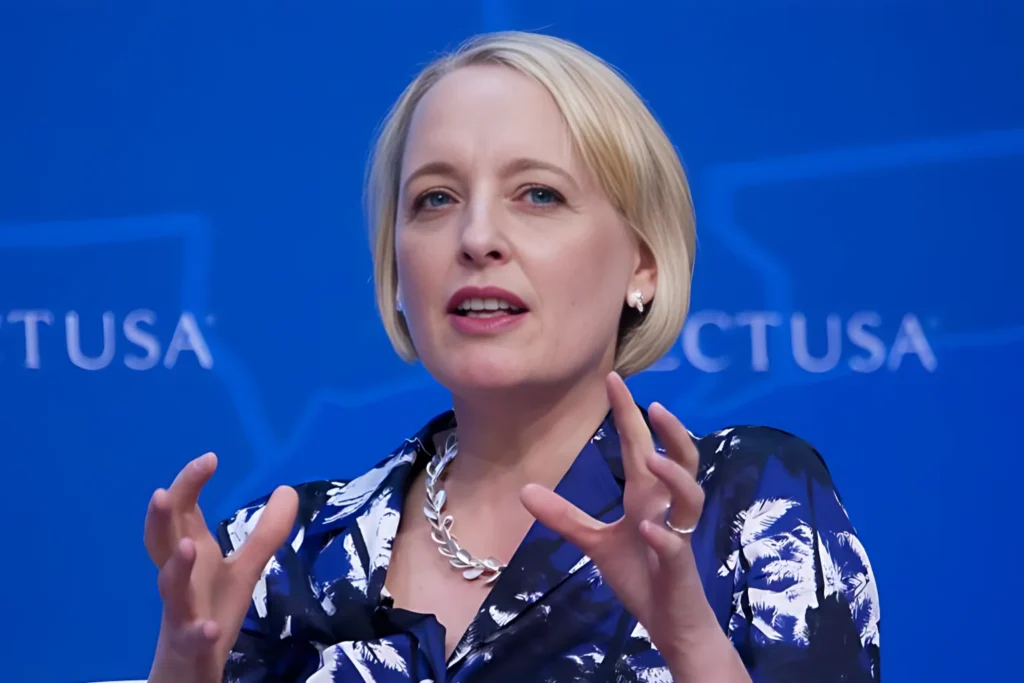
Accenture CEO Julie Sweet has delivered a direct message to the company’s 770,000-plus employees: proficiency with its AI tools is now required for promotion. Speaking on the Rapid Response podcast in March 2026, Sweet made clear that career advancement at the global consultancy depends on using the very AI systems that power Accenture’s operations.
This isn’t sudden. Over three years, Accenture has rolled out user-friendly AI workbenches, trained hundreds of thousands of staff, and invested billions to make AI central to how work gets done. For U.S. entrepreneurs, professionals, and investors, Sweet’s stance signals a broader truth: AI skills are no longer optional—they drive productivity, revenue growth, and personal wealth in an economy where companies that adapt fastest win. Ignoring this shift risks stalled careers and missed opportunities in high-paying fields.
What Accenture CEO Julie Sweet’s AI Mandate Means
Julie Sweet, Chair and CEO of Accenture since 2019, has steered the firm through digital transformation. Her latest directive ties promotions directly to AI usage. “If you want to get promoted, you’ve got to do the things that we do to operate Accenture,” she told the podcast host.
Sweet compares today’s AI training to the 1980s shift from typewriters to computers—standard business practice, not coercion. The policy evolved gradually: first making tools accessible, then embedding them in workflows, and finally linking them to advancement.
Why Accenture CEO Julie Sweet’s AI Mandate Matters in Modern Business & Finance
AI proficiency directly impacts growth and stability. Accenture’s own results prove it. In Q1 fiscal 2026, advanced AI bookings hit $2.2 billion (up 76% year-over-year), while advanced AI revenue surged 120% to $1.1 billion. Overall revenue reached $18.7 billion, with strong profitability.

For professionals, mastering AI boosts output by 30-40% in routine tasks, according to industry benchmarks, freeing time for high-value work. Entrepreneurs who rewire operations around AI capture market share faster. Investors see higher returns in AI-forward companies. Sweet’s approach shows that early adopters build resilient careers and businesses in a $70 billion-plus consulting giant that continues to expand headcount while optimizing for AI.
7 Proven Strategies for Mastering AI Skills Like Accenture Employees
1. Start with daily integration
Treat AI as a core tool, not an add-on. Use generative AI for drafting reports, analyzing data, or automating client communications—just as Accenture does. Track time saved weekly to build momentum and demonstrate value in performance reviews.
2. Commit to structured reskilling
Follow Accenture’s model: dedicate 5-10 hours monthly to targeted training. Platforms like Coursera’s AI courses or Microsoft Copilot certifications mirror the firm’s $3 billion, three-year plan that grew its AI workforce toward 80,000 professionals.
3. Rewire workflows around AI
Redesign processes instead of bolting AI onto old ones, as Sweet advises CEOs. Map your business operations, identify repetitive tasks, and embed tools like ChatGPT Enterprise or custom agents. This creates measurable efficiency gains.
4. Measure and document results
Quantify impact—time saved, revenue generated, or errors reduced. Accenture ties promotions to demonstrated use; professionals should do the same with portfolios or quarterly reports showing AI-driven outcomes.
5. Build team-wide adoption
For entrepreneurs, train your staff early. Create internal “AI workbenches” with shared prompts and templates. Accenture reskilled 550,000 employees on generative AI fundamentals—scale this mindset to stay competitive.
6. Seek feedback and iterate
Use AI tools’ built-in analytics or manager input to refine usage. Sweet emphasized humility and courage during transition—regular reviews prevent stagnation and accelerate mastery.
7. Align with company culture
In job interviews or promotions, highlight AI proficiency explicitly. Mirror Accenture’s three-year rollout: start small, prove value, then lead change to position yourself as indispensable.
Common Business & Financial Mistakes to Avoid
Many professionals treat AI as optional or a one-time experiment, then wonder why promotions pass them by. Others resist change, fearing job loss, instead of embracing it as Accenture did—resulting in “exits” during the $865 million 2025 optimization program.
A bigger error: layering AI onto fragmented processes without rewiring. Sweet warns this limits value. Finally, skipping measurement—without data on productivity lifts, leaders can’t justify investments or career claims.
Tools or Resources That Help With AI Mastery
Accenture built proprietary platforms; individuals can use free or low-cost alternatives: Microsoft 365 Copilot, Google Gemini for Business, Notion AI, and Zapier for automation. For structured learning, LinkedIn Learning’s AI paths or Accenture’s public insights via their website provide blueprints. Track progress with tools like Toggl for time savings or custom dashboards in Excel with AI add-ins.
Real-World Example or Case Study
Accenture itself is the prime case. Starting with a 2023 $3 billion AI reskilling commitment, the firm trained over 550,000 staff, invested $865 million in 2025 optimization, and now requires AI proficiency for promotions. Result: surging AI bookings, revenue growth at the top of guidance, and continued headcount expansion despite targeted exits. Entrepreneurs replicating this—gradual rollout, measurement, and cultural shift—see similar gains in efficiency and market positioning.
Future Trends in AI-Driven Career Advancement
By 2029, AI’s addressable market exceeds $70 billion with 40%+ annual growth. Expect AI agents to handle complex workflows, making proficiency non-negotiable for leadership roles. Companies will tie compensation and promotions to AI metrics. For U.S. professionals, those who invest now will lead in high-growth sectors like consulting, finance, and tech—building wealth through higher salaries, equity, and entrepreneurial success.
Final Thoughts, Accenture CEO Julie Sweet’s message is clear and timely: AI is how modern companies—and careers—operate. By adopting her proven playbook of reskilling, integration, and measurement, entrepreneurs and professionals can future-proof their paths to promotion and prosperity. Start today; the three-year head start Accenture gave its workforce is now your competitive edge.
For more Powerful Articles on Career Growth, Net worth milestones, and Self-Improvement strategies, visit RIGHWAY daily.
Does Accenture require AI skills for promotion?
Yes. Accenture CEO Julie Sweet stated on the Rapid Response podcast that employees must demonstrate proficiency with the company’s AI tools to qualify for promotion. The requirement follows three years of gradual rollout and training.
How much is Accenture investing in AI reskilling?
Accenture committed $3 billion over three years starting in 2023 and added $865 million in a 2025 six-month optimization program focused on upskilling and targeted exits for non-adapters.
What AI training has Accenture completed?
The firm has trained more than 550,000 employees on generative AI fundamentals as part of its push to reach 80,000 AI and data professionals through hiring, acquisitions, and internal programs.
Why does Julie Sweet compare AI to computers?
Sweet notes that requiring computer use decades ago was never called coercion—it was simply how business operated. Today, AI at Accenture is the same standard for getting work done and advancing careers.
How can professionals apply Accenture’s AI strategy?
Assess skills, integrate tools daily, measure results, and rewire processes around AI. Document outcomes for promotions or business growth, mirroring Accenture’s data-driven approach that fueled record AI revenue growth.